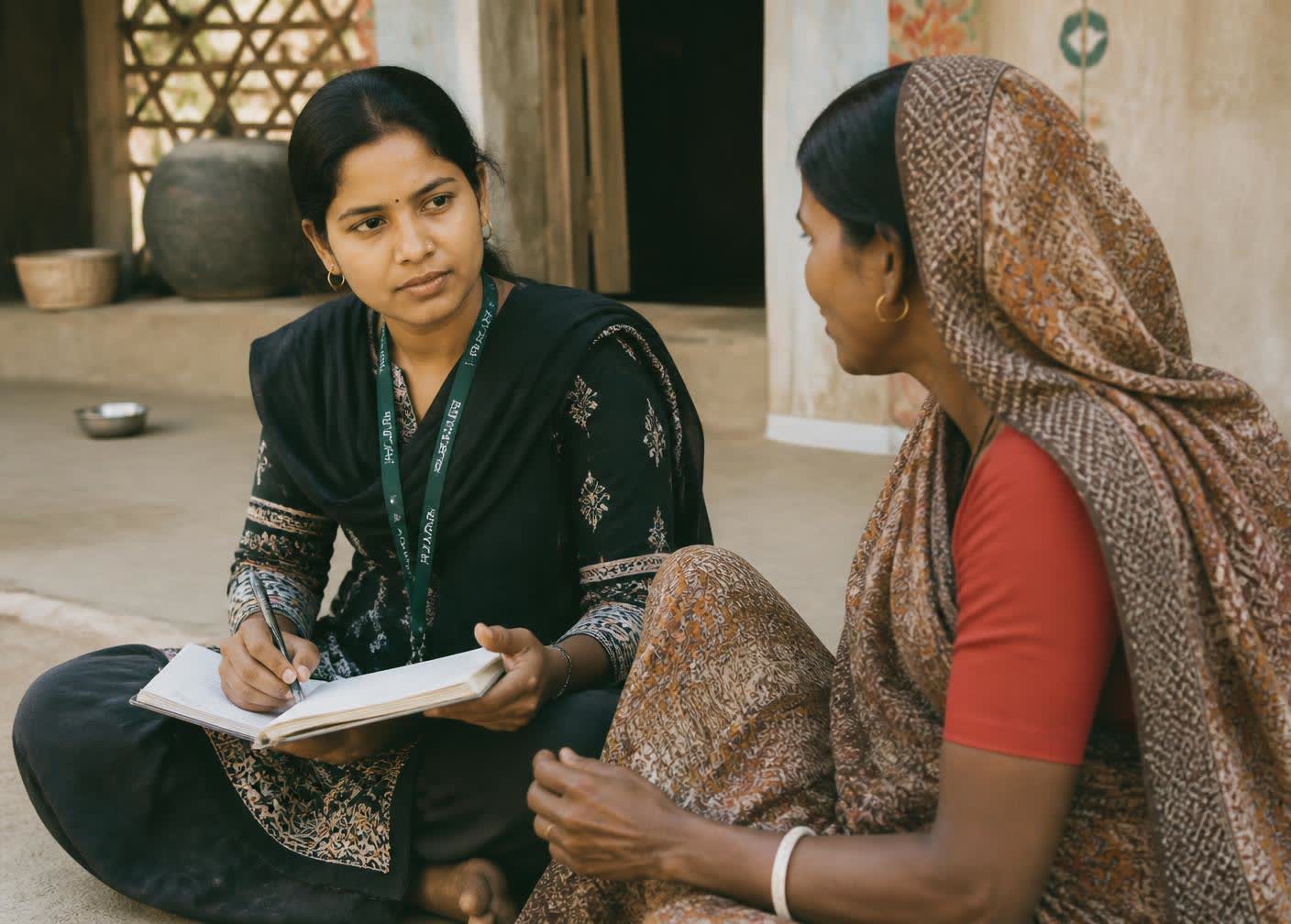
We start by listening
Every intervention begins with the worker’s own account of what happened. We do not arrive with a solution already decided; the case is shaped by the person living it.
Who we are
Mehnatkash Association works alongside bonded, migrant and informal workers across northern and central India — connecting immediate relief with legal intervention, welfare access, worker organising and evidence-based advocacy.
Our story
Mehnatkash Association was formed in Delhi in December 2022 by field workers, lawyers and researchers who kept meeting the same problem from different directions: the protections that exist on paper for India’s informal workforce almost never reach the people they were written for.
Around ninety per cent of India’s workforce is informal. Brick kilns, quarries, carpet units, farms, construction sites and domestic work run on labour that is largely undocumented, frequently migrant, and often bound by an advance that can never quite be repaid. When wages are withheld or documents seized, the law is not the obstacle — reaching it is.
We work in the gap between the two. That means sitting in a kiln settlement long enough to understand what actually happened, and then filing the complaint, accompanying the worker to the hearing, and staying until the wages are recovered and the family is linked to the entitlements they were always owed.
Where we work
Bonded and migrant labour does not respect district lines. Our teams work at both ends of the migration corridor — the villages workers leave and the worksites they arrive at — so a case does not collapse when someone crosses a border.
20,664
Labourers rescued
Forced and bonded workers freed
15
States of operation
Where our teams work directly
945
Cases in progress
Across quasi-judicial and administrative forums
2022
Registered
New Delhi
How we work
These are not aspirations on a wall. They are the rules we apply when a case is ambiguous and someone has to make a call in the field.
Every intervention begins with the worker’s own account of what happened. We do not arrive with a solution already decided; the case is shaped by the person living it.
Wages, compensation and release are entitlements under law. We frame our work as enforcement of existing rights rather than as favours granted to the vulnerable.
A release certificate is a beginning. We stay with a case through wage recovery, welfare linkage and rehabilitation, because dignity has to outlast the intervention.
Field evidence becomes case files, and case files become policy submissions. Systemic change needs a record that holds up in a courtroom and a ministry alike.
Committees, paralegals and women’s collectives mean the next violation is met by an organised community rather than by us alone.
Cases involving children, trafficking or ongoing threat are handled under restricted access. Protection of the person always outranks the visibility of the work.
The Mehnatkash pathway
Our anti-bonded-labour pathway is built on field practice. Each stage has to close before the next one means anything.
A complaint arrives through our helpline, a field visit or a worker committee. We record the account, assess immediate risk and open a case file with a reference the worker can quote back to us.
Field teams corroborate the account at the worksite and with the community — employment terms, advances taken, documents withheld, conditions of movement.
Where bondage is established we coordinate with the district administration and police for release, and press for the release certificate that unlocks statutory rehabilitation.
Complaints are drafted and filed — wage recovery before labour authorities, criminal complaints where warranted, and RTI applications to force disclosure.
We connect workers and their families to e-Shram, pensions, ration entitlements, health referrals and compensation schemes they are already eligible for.
Skills training, self-help groups and enterprise support so that no family has to take the advance that starts the cycle again.
Patterns across cases become policy briefs and legal submissions, so that a problem solved once for one worker gets solved structurally for many.
We do not stop at rescue. A release certificate that is not followed by wages, welfare and a livelihood is a piece of paper, not a rehabilitation.
Whether you need help, want to volunteer your time, or can fund the legal work — there is a way in.